Wednesday, June 27, 2012

Shake that broom


'Tis the gift to be simple, 'tis the gift to be free,
'Tis the gift to come down where we ought to be"
- Shaker hymn

If you're familiar with the Shakers, then you probably know about the lovely boxes they made. And perhaps Shaker furniture. But for a religious group that embraced "Simple Gifts" they were surprisingly inventive. According to Wikipedia...

"Shakers won respect and admiration for their productive farms and orderly communities. Their industry brought about many inventions like Babbitt metal, the rotary , the circular saw, the clothespin, the Shaker peg, the flat broom, the wheel-driven washing machine, a machine for setting teeth in textile cards, a threshing machine, metal pens, a new type of fire engine, a machine for matching boards, numerous innovations in waterworks, planing machinery, a hernia truss, silk reeling machinery, small looms for weaving palm leaf, machines for processing broom corn, ball-and-socket tilters for chair legs, and a number of other useful inventions. Shakers were the first large producers of medicinal herbs in the United States, and pioneers in the sale of seeds in paper packets"
Perhaps lost in the list above is "flat broom". What, you ask, could there be any other shape for a broom?  Slate magazine has well-written history of the broom,
bundles of twigs, reeds, corn husks, and other natural fibers have almost certainly been used since ancient times to sweep up ash and embers around fires and, later, hearths. 
“what woman having ten pieces of silver, if she lose one piece, doth not light a candle, and sweep the house, and seek diligently till she find it?” - Luke 15:8
For over two thousand years brooms looked like the image at right; what we think of today as a witch's broom and sometimes called a "besom" broom. About 200 years ago, farmer Levi Dickinson discovered that a sorghum grass, now called "broomcorm" made a great besom broom. This was modernized and sold in mass production.
"The Shaker intervention [...] was simple but ingenious: Instead of lashing the broomcorn in a round bundle to the handle, they found that securing the corn with wire, flattening it with a vice and sewing it tight resulted in superior cleaning tool. [...] The Shakers also pioneered the smaller whisk broom, perfect for one-handed dusting and sweeping of higher surfaces" - Slate.com
Next time you use a flat broom, give a prayer of thanks to the Shakers.

Labels: ,

Monday, September 26, 2011

How can you NOT know what year you were born?

"But at my back I always hear
Time's winged chariot hurrying near"
- To his Coy Mistress, by Andrew Marvell

I enjoy doing genealogy, especially now-a-days with so many resources available on the Internet. But one thing always amazes me: the multiplicity of dates listed for the life event of a single person. A relative might be online as born on 15/1/1753 or 1/15/1752 or 15 Jan 1752/3 or 26 Jan 1753 or 1 Feb 1753 and all could be correct to some degree. How can that be?

The answer begins with the year 1582 when the Catholic church took action regarding calendar creep. The Julian calendar used since ancient Rome had a leap year every four years which is very good but still has an error of 11 minutes per year compared to the sun. By the 1580's this had accumulated to 10 days of error. In 1582 Pope Gregory XIII decreed changes:
1. All calendars in October would be advanced by 10 days to sync with the sun
2. Leap year would be skipped in years divisible by 100 (l900 was not a leap year) unless also divisible by 400 (so 2000 is a leap year) to eliminate the small drift.

Now this occurred after the Protestant Reformation so many countries ignored the papal decree which led to more confusion as different countries had different dates. Imagine it's Oct 11 in Italy with a contract to deliver something to Germany on their Oct 2, tomorrow. Eventually all(?) countries updated their calendars to the Gregorian system. This did not occur until 1752 in England by which point they had to skip 11 days to catch up. Wednesday, 2 September 1752 was followed by Thursday, 14 September 1752.

Back to genealogy: John Smith was born Jan 15th, 1752 so this was just before the calendar change in September in England, right? Wrong. Like many murder mystery novels I've held back a vital clue. Gregory also changed the start of the year from March 25 to January 1. Under the old calendar the year went Nov 1752, Dec 1752, Jan 1752, Feb 1752, March 1752, April 1753 (new year).  Jan 15 was very late in the year 1752 under the Julian calendar but would be listed as 1753 under new system. Genealogists recommend writing this as 15 Jan 1752/3.

The change of starting month also affects Quaker dates. [I have a lot of Quakers in my family tree.] Quakers refused to use the days of the week names since this mention foreign gods: Thursday (Thor), Wednesday (Odin or Wodin), Saturday (Saturn). So they would list a birth as the 15th day of the 1st month of the year 1752. But what is the 1st month?  It was March prior to 1752 and January afterwards.

When doing genealogy dates should be written as
day(#) Month(full or 3 letter abbreviation) year(4 digits)
to avoid the confusion of the American 1/15/1752 vs the European 15/1/1752 for the same date. I saw this problem in a British relative last night - some records said  7 Oct and others 10 July - clearly someone was confused over 10/7 vs 7/10.

But the confusion does not stop there. Some people try to be helpful by "correcting" dates from the Julian to Gregorian (especially if the person was born under one calendar and died under the other). They add 11 days to the birthday so John Smith gets a birth date of 26 Jan 1753. The trouble is how do I know if the date was adjusted or not? I don't. Hence the formula  15 Jan 1752/3 to indicate a Julian date between Jan 1 to March 24 without "correction".

Bottom Line

If you follow the rules above will you have the correct date? Maybe not. There's one more common point of confusion. Many dates are taken from old church records which typically record the Christening date (baptism) and the burial date instead of the birth date and date of death. In my example at top, 1 Feb 1753, might be the baptismal date and entered mistakenly as the birth date for John Smith. It's important to know what event the date represents.

Labels: , , ,

Sunday, August 28, 2011

Reformed Theology

God made so many different kinds of people. Why would he allow only one way to serve him?
~Martin Buber

Recently I was reading a Survivalist blogsite with articles on "prepper" friendly churches; i.e. churches that encourage preparing food storage and supplies for coming "bad times". One person recommended the Confederation of Reformed Evangelical Churches (CREC) which I had never heard of before. The blogger described them as follows...
The various confessions to which CREC members hold are as follows:

•Westminster Confession of Faith
•The Savoy Declaration
•The London Baptist Confession
•American Westminster Confession of Faith
•The Reformed Evangelical Confession

•The Three Forms of Unity:
 Belgic Confession
 Heidelberg Catechism
 Canons of Dort
Huh? Several months back I listened to a lecture series on the history of Christian religion and vaguely remembered some of these terms. Here is what Wikipedia has to say. Apologies to Reformed Church members for any mistakes I make below. This is all new to me.

Westminster Confession of Faith was drawn up in 1646 in England and is used (with some modifications) by Presbyterians, Congregationalists, and Baptists. The modifications made by English Congregationalists in 1658 is called the Savoy Declaration. After the Revolutionary War in 1789, the American Congregationalists removed references to the Church of England in the American Westminster Confession of Faith.
The Baptist Church in England wrote their First Confession of beliefs in 1644, two years prior to Westminster. But the Westminster Confession contained more details and became the approved standard in England. In 1677 the Baptists created a new London Baptist Confession modeled after Westminster.

I'm not sure what the Reformed Evangelical Confession is. There's no link on Wikipedia and the CREC website says only (see Article XII).

The original Westminster Confession of Faith consists of 33 chapters describing beliefs and doctrine:
1 Of the Holy Scripture.
2 Of God, and of the Holy Trinity.
3 Of God's Eternal Decree.
4 Of Creation.
5 Of Providence.
6 Of the Fall of Man, of Sin, and of the Punishment thereof.
7 Of God's Covenant with Man.
8 Of Christ the Mediator.
9 Of Free Will.
10 Of Effectual Calling.
11 Of Justification.
12 Of Adoption.
13 Of Sanctification.
14 Of Saving Faith.
15 Of Repentance Unto Life.
16 Of Good Works.
17 Of The Perseverance of the Saints.
18 Of the Assurance of Grace and Salvation.
19 Of the Law of God.
20 Of Christian Liberty, and Liberty of Conscience.
21 Of Religious Worship and the Sabbath-day.
22 Of Lawful Oaths and Vows.
23 Of the Civil Magistrate.
24 Of Marriage and Divorce.
25 Of the Church.
26 Of the Communion of the Saints.
27 Of the Sacraments.
28 Of Baptism.
29 Of the Lord's Supper.
30 Of Church Censures.
31 Of Synods and Councils.
32 Of the State of Man After Death, and of the Resurrection of the Dead.
33 Of the Last Judgment.

•The Three Forms of Unity predate Westminster and is a collective name for the official statements of doctrine of Dutch Calvinists and many Reformed Churches. From 1618 to 1619 the Dutch government, on behalf of the Dutch Reformed Church, gathered Dutch delegates along with twenty-seven Reformed representatives from eight other countries to meet at a Synod of Dort, where they summarized their views in what was called the Canons of Dort. The Synod also approved two other documents used by the Dutch Reformed Church: the Heidelberg Catechism (1561, a question-and-answer format explaining biblical teaching to children and those new to the faith) and the Belgic Confession of Faith (1563). The Belgic Confession consists of 37 articles in memorizable paragraphs on the doctrines of God, Scripture, sin, salvation, and the end times. The original Belgic (Belgium) Confession in French cites scripture passages for each belief in the margins.

Bottom Line

As I wrote the above I became confused. The CREC does not list beliefs but rather multiple belief documents (called confessions). How can an organization say it "holds to" multiple confessions of faith which contain differences one from another? 

The CREC offers this explanation:
4. Why does the CREC allow so many different Confessions? Won’t this breed conflict?
It will certainly breed discussion, and the Bible tells us to strive for like-mindedness, which cannot be done without contact with one another. We have agreed on the basics of the gospel in such a way as to promote unity where we currently differ. We believe our unity is to be founded in confessional truth, and therefore we want our association with other faithful churches to facilitate the opportunity for striving for greater unity.
A wonderful statement.

During the Reformation hundreds of thousands died in Europe for the Confessions above. Catholics and Protestants fought each other and even Protestants killed Protestants over differences in beliefs (e.g. adult vs infant baptism). Several centuries before the Reformation, Catholics killed Catholics over "heretical" beliefs (e.g. is Jesus created by God and a lesser being or co-equal to God ["begotton not made"])?

It's great to see an organization of Churches that can agree to disagree on some details and work together peaceably.

Labels: ,

Monday, July 11, 2011

"Oh, God!", the movie

"My days are all filled with an easy country charm
Thank God I'm a country boy"
- John Dever lyrics
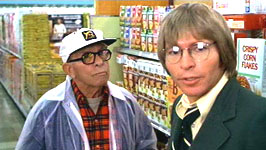
In my last post I used a quote from the movie, "Oh, God!" about the avocado pit. I really loved that movie when it came out in 1977. George Burns plays a great God, all knowing with a bit of humor. His reluctant prophet, Jerry Landers, is played by John Denver. Here are some more quotes from that movie.

Jerry Landers: How can you permit all the suffering that goes on the world?
God: Ah, how can I permit the suffering?
Jerry Landers: Yes!
God: I don't permit the suffering. You do. Free will. All the choices are yours.

Jerry Landers: I don't even go to any church!
God: Neither do I.

Jerry Landers: People are always praying to You. Do You listen?
God: I can't help hearing. I don't always listen.
Jerry Landers: So then You don't care.
God: Of course I care! But what can I do?
Jerry Landers: What can You do? You're God!
God: Only for the big picture. I don't get into details.

God: The last miracle I did was the 1969 Mets. Before that, I think you have to go back to the Red Sea.

Jerry Landers: I lost my job, you know. [after speaking as God's prophet]
God: [shrugs] Lose a job, save a world. Not a bad deal.

The tail end of the movie has Jerry Landers on trial as a false prophet. God appears as a witness and when asked if he swears to tell only the truth responds, "So help me, me. <pause> I'm God", which naturally causes an uproar. He then explains....
God: Why is it so hard for you to believe? Is my physical existence any more improbable than your own? What about all that hoo-ha with the devil awhile ago from that movie? [The Exorcist] Nobody had any problem believing that the devil took over and existed in a little girl. All she had to do was wet the rug, throw up some pea soup and everybody believed. The devil you could believe, but not God? I work in my own way. I don't, I don't get inside little children; they got enough to do just being themselves. Also I'm not about to go around to every person in the world and say, 'Look it's me, I wanna talk to you.' So I picked one man. One very good man. I told him God lives. I live. He had trouble believing too, in the beginning. I understood. I'm not sure how this whole miracle business started, the idea that anything connected with me has to be a miracle. Personally I'm sorry that it did. Makes the distance between us even greater.

[last lines of the movie as God says goodbye to his prophet]
Jerry Landers: Maybe, sometimes... couldn't we just talk?
God: I'll tell you what. You talk... I'll listen.

Bottom Line

What lines from the movie do you agree with? Which parts did it get wrong?

Labels:

Thursday, June 30, 2011

Conservatives vs Liberals

Conservatives divide the world in terms of good and evil while liberals do it in terms of the rich and poor.
- Dennis Prager
Last night I chanced into a conversation about Conservatives. Someone had written, "Conservatives support the King and are opposed to freedom".  Huh, I replied? I was told this was part of a college paper about France just before the revolution. OK, that made more sense but I then tried to explain that Conservatives are not anti-freedom. Instead they are anti-change (usually) and particularly anti-anarchy.

Conservatives believe their world is good and things can only change for the worse.
Liberals believe the world is in bad shape and that things can only change for the better.

Both are half-right, half-wrong. Not everything is good, there is suffering and misery, but not all change is for the better. Conservatives need to do a better job of explaining why certain liberal ideas are dangerous (based upon history and experience) and do a better job addressing problems instead of living in the status quo.

This morning I came across a blog with a different comparison of Conservatives vs Liberals. It comes on the tail of the story about popular Democrat Anthony Weiner who was accused of sending a picture of his crotch (in shorts) to a girl via Tweet. At first he denied it and said he was hacked. Some left-leaning media blamed the right-leaning Andrew Breitbart for framing him or making it up. But then under mounting evidence and the account of several women, Weiner admitted it and apologized to Breitbart. So what was the Liberal media response to being wrong? Apologies? No. Instead they counter attack with "At least Weiner is not a hypocrite".

What does this mean, asks a blogger named Zombie.


How can this be? Why are conservatives hypocrites when they err but not liberals? Zombie expands his diagram to show the unspoken assumptions behind the argument.

"Remember, that’s not my characterization of liberalism — that’s liberals’ own characterization of themselves when they use this argument", says Zombie. In the extreme liberal world everything is tolerated and allowed, there is no "wrong", so there is no sin. The hypocrite defense claims that only people who believe in sin can be held accountable for sinning.

Bottom Line

Zombie comes to a close with a nice analogy:
Consider these two statements from two different potential husbands:
“I know I promised to stop drinking forever, honey, but I fell off the wagon again; please forgive me, and I’ll really really try to stay sober from now on, but no guarantees.”
vs.
“I’m a tertiary alcoholic, a stone-cold drunk; always have been, always will be. You’re not likely to ever see me sober. Take it or leave it.”
If you had to choose, which would you marry?

Labels: , , , ,

Wednesday, June 29, 2011

Erasmus of Rotterdam

"When I get a little money I buy books; and if any is left I buy food and clothes"
- Erasmus of Rotterdam (1466 – 1536)
The quote above has always been one of my favorites but I had no clue who Erasmus was. He wrote much and is much quoted, see http://www.brainyquote.com/quotes/authors/d/desiderius_erasmus.html

Other famous quotes include:
  • "In the country of the blind the one eyed man is king."
  • "Prevention is better than cure."
  • "To know nothing is the happiest life." (Ignorance is bliss)
  • "Women, can't live with them, can't live without them."
So who is this Erasmus of Rotterdam? He was in his day a hero and villain but now mostly forgotten. In his home town the University and High School have been named in his honor but in 2003, a poll showed that most Rotterdammers believed Erasmus to be the designer of the local "Erasmus Bridge".

Erasmus was a Dutch Renaissance humanist ("Prince of the Humanists"), Catholic priest, and a theologian. He was excellent at Greek and Latin and translated many works such as Saint Ambrose, Aristotle, Saint Augustine, Saint Basil, Saint John Chrysostom, Cicero and Saint Jerome. Ten columns of the catalogue of the British Library are taken up with the bare enumeration of Erasmus's works and their subsequent reprints. He corresponded with more than five hundred men in the worlds of politics and of thought.

Erasmus led a "normal" though busy life as a translator until 1514 when he decided to produce a new and definitive Latin translation of the New Testament (he despised the poor "Vulgate" Latin in use up to that time). He gathered all the Latin and Greek Bibles he could find and started comparing them. He "corrected" many mistranslations and to prove that he was right when challenged, published the Greek alongside the Latin for scholars to compare. He raised questions about some practices of the Catholic Church based upon mistranslations.

Martin Luther was inspired by Erasmus's translation and observations and a year later the Reformation began. Initially Erasmus was sympathetic to Luther's criticisms, describing him as "a mighty trumpet of gospel truth" and admitting that, "It is clear that many of the reforms for which Luther calls are urgently needed.” For this Erasmus was an early hero of the Reformation. BUT he never left the Catholic Church and never gave his full support to Luther. For this he was vilified by the Reformation after his death.

"We are dealing with this: Would a stable mind depart from the opinion handed down by so many men famous for holiness and miracles, depart from the decisions of the Church, and commit our souls to the faith of someone like you who has sprung up just now with a few followers, although the leading men of your flock do not agree either with you or among themselves – indeed though you do not even agree with yourself, since in this same Assertion you say one thing in the beginning and something else later on, recanting what you said before."
-Erasmus to Luther on why he remains Catholic
Likewise the Catholic Church praised Erasmus while he lived because he criticized Luther. Moderate Catholics appreciated that he had been a leading figure in attempts to reform the Church from within. But by 1560 the Pope blamed Erasmus for having "laid the egg that hatched the Reformation". All of his works were placed on the Index of Prohibited Books by Paul IV.

Bottom Line

During the Reformation Erasmus refused to takes sides. He wanted Reform but ony from within the Church. The Protestants would despise him for criticizing Luther. The Catholic Church would reject him for not criticizing Luther strongly enough. No one likes a fence-sitter.

KJV Revelation 3:15-16 I know thy works, that thou art neither cold nor hot: I would thou wert cold or hot. So then because thou art lukewarm, and neither cold nor hot, I will spue thee out of my mouth.

Labels: ,

Sunday, April 24, 2011

Easter Sunday


A Blessed and Joyous Easter to All!

Labels: , ,

Monday, January 10, 2011

The Universe is HUGE

When you are put into the Vortex you are given just one momentary glimpse of the entire unimaginable infinity of creation, and somewhere in it a tiny little mark, a microscopic dot on a microscopic dot, which says, "You are here." - The Total Perspective Vortex from the Hitchhiker's Guide to the Galaxy

Click for larger image
The image above might look like the night sky but it's much, much bigger. The 250 billion stars of our Milky Way Galaxy fall along the blue fuzzy bar in this computer plot. The white dots in this image are not stars, they are galaxies. Each of the 1.6 million white dots represents a known galaxy, each with hundreds of billions of stars. The total number of stars visible to us exceed 70 sextillion (7 x 10²² ).

Bottom Line

For me it is hard to see a picture like this and assume that we are alone. That all this exists and we are the only life amongst 70 sextillion stars?

Labels: , , ,

Tuesday, November 23, 2010

Truth is stranger than fiction

“Space flights are merely an escape, a fleeing away from oneself, because it is easier to go to Mars or to the moon than it is to penetrate one's own being” - Carl Jung
Here are two pictures from one of my favorite websites, Astronomy Picture of the Day. What is it about orbiting particles that they flatten out and form a disk? Consider the solar system - the planets, asteroids, and most comets all lie in the same flat plane aligned with the equator of the sun. Why not spin about the sun at all angles? Two other examples are easier to visualize. The rings of Saturn are very thin as show in this photo. Note also the cool shadow of the rings on the planet.


Here's a photo of a distant galaxy that we see exactly on edge instead of the typical view from above with spirals. Observe how thin the galaxy is with a thin ribbon of bright stars.


Bottom Line

In college I studied mathematics up to a Doctoral Candidate level. (I did not complete a thesis, though I tried twice over two years. Both times another university disproved what I was asked to prove by my advisor.)  And yet the hardest "math" classes I attended were physics classes. One class used tensor (i.e. 3-D) calculus to study the curvature of space about black holes. Reality can get very weird when gravity and spinning are combined.

Last night I saw a film clip of the famous physicist, Richard Feynman, who was asked "why" magnets push on each other. He said he could not explain it unless you already had a solid grounding of physics. Not because he was a poor teacher but because the magnetic force is so fundamentally an aspect of the universe that there was nothing to compare it to as an example. One could compare it to the push/pull of the electrical force but physicists now know that magnets and electricity are the same force so this is merely comparing magnets to itself. He could over-simplify and say the force was like rubber bands. But then if you were to ask him why rubber bands snap back he'd have to admit that, at the lowest level, it was the electrical force behind the pull so we're back to explaining in circles.

This reminds me of the conundrum, how do you explain the taste of salt? What can you compare it to? 

Often we paint Science and Religion as opposites but as Feynman observed, science is built upon basic principles, statements of reality that must be accepted in order to work at higher levels of reality. One could think of these principles as a type of "faith". For example, do we really know that quarks exist? By theory they can never be observed in isolation only through their interaction. How different is this from Faith when defined as belief in something unseen (but felt)? Believers will say they have felt the interaction of God.

I was going to appease scientists by saying that Science differs from Religion in that the fundamental principles change over time as we learn more about reality through experiments and observations. We no longer believe that everything is made of earth, fire, air and water. We've moved from a particle theory of atoms to wave-particle duality. There is some evidence that the physical constants of the universe may not be constant after all but change over time or space. Scientists see themselves as willing to change theories when presented with the "facts".

But what is truth? Science, like Religion, can be influenced by majority opinions - is global warming real? If real is it man made? Scientists argue over this just like theologians with conflicting evidence and with as much venom and anger and emotions. Is string theory real? Is the universe 11 dimensions? What exactly is gravity? We don't really know how the universe works at its lowest levels but one can pick a theory and choose to believe it. Much like picking a Church to follow with its own unique rules and explanations for reality.

Labels: , , , , ,

Thursday, August 26, 2010

Food Storage, part 2

"Many more people could ride out the storm-tossed waves in their economic lives if they had their … supply of food … and were debt-free. Today we find that many have followed this counsel in reverse: they have at least a year’s supply of debt and are food-free.” - Thomas S. Monson
After promoting a one-year supply of food storage for decades, in 2007 the Mormon church lowered the bar and now recommends acquiring a 3-month supply instead. The one-year target was just too difficult and many Latter-Day Saints never even tried to reach it. Now the advice is to build slow and steady over time and within budget. For those that reach 3-months, they are encouraged to keep stockpiling for "long-term" but long-term is not specified as to how long.

Shortly after I was married, my wife and I were able to build up a 3-month supply using pasta, canned foods and other easy to buy items. We talked about 1-year but didn't seriously try for it until the Y2K scare when bulk food became readily avaiable. I don't know if we still have a one-year supply or not. We have not updated the inventory in quite a while.

Planning for 3-months or 90 days is so much easier.
  1. Pick 9 favorite recipes each for breakfast, lunch, snack and dinner that can be made from food storage. See http://preparedldsfamily.blogspot.com/2009/06/3-month-food-storage-90-menu-ideas.html for ideas.
  2. Figure out the amount of ingredients for each recipe to feed your family.
  3. Multiply by 10. (This means adding a zero after the amounts.)
  4. Add up the total ingredients and figure out what you need to buy. For example if you need 1000 tsp of salt, how many salt containers will that be? A tsp of salt is typically 6g according to Google. The common 26 oz salt container is 737 grams which means 737 / 6 = 122 tsp of salt per container. So 1000 tsp / 122 = 8 full containers and a little extra. I'd buy nine to allow for wastage and spillage.
  5. Begin stocking up on supplies until you have have enough to make each of the 27 recipes 10 times.
  6. Use the supplies and replace them to keep them fresh.
  7. Don't forget to include water for the recipes and beverages for the family.

Bottom Line
Don't be scared off by the math above. It only gets complicated if you use real recipes from scratch.
If the math and adding up ingredients is too much, work out a plan based upon boxes and cans instead. Say one box of cereal per person for 9 days. Will every breakfast be cereal? Then each family person will need 10 boxes of their favorite cereal (and don't forget water and powered milk for it.)  If you alternate cereal with breakfasts of pancakes or muffins or oatmeal then buy only half as much for 45 days of cereal, 5 boxes per person.

Labels: , ,

Tuesday, June 22, 2010

Death vs Risk

"Death is not the greatest loss in life. The greatest loss is what dies inside us while we live."-Norman Cousins

My current Commuting to Work CD Lecture Series is about the religious upheaval of the Reformation. In the first lecture, the professor made an interesting comment - religion was a serious matter back in the 1500s. Before modern medicine and modern hygiene, people died all stages of life, especially children. Someone might be healthy today but die tomorrow. Life was short and uncertain and no one truly knew what was safe. Many thought the chill of cold water when bathing was unhealthy. Some thought mercury or arsenic was good for the body. Death was beyond anyone's control.

"But at my back I always hear. Time's winged chariot hurrying near"
- Andrew Marvell in "To his Coy Mistress"

"Because I could not stop for Death, He kindly stopped for me;"
- poem by Emily Dickinson

With death never far away, people were naturally concerned with their soul and the judgement of God. Would they go to heaven if they died the next day? How could they improve their odds for salvation? They relied on the Roman Catholic Church to save them both in life and after death. For example, in the 1500's it was very popular to purchase salvation through the buying of indulgences. Martin Luther objected to this practice in his 95 Theses and the Reformation began.

Today life expectancy is quite long and most people expect to live to a ripe old age. Yes accidents happen but these are rare exceptions. We now live in the material world for many, many decades and the spiritual world is something distant and far off, something to be put off until we're old.

I was reminded of this topic this weekend when discussing risk and what children used to do versus what we allow children to do now-a-days. With a long life expectancy, we fear death more. We have so much more life to lose from an early death caused by accident or disease. Instead of death being a part of life, we do everything in our power to keep death away from the young. Don't climb that tree, you might break your neck. Wear a helmet when you ride your bike. Don't eat that, it's filthy with germs. The odds of a child dying from tree climbing, etc are low but the odds are greater than zero. That makes many parents nervous and they limit opportunities and actions of their kids to lower the risk to as near zero as possible.

"A coward dies a thousand deaths, the brave die but once."
- Shakespeare in Julius Caesar

A life of zero risk and zero exposure has it's own risks. Science is finding that when young children are not exposed to germs, they develop more severe allergies and have less immunity when they grow up. An isolated, at-home child will have weaker social skills which could impact their success on the job later in life.

Bottom Line

Isaiah 22:13 "Let us eat and drink; for tomorrow we shall die."
Don't be so afraid of death that you run away from life. Embrace life and accept a little risk. Live a little. But don't forget the golden mean and go crazy in excess. Personally I'll pass on bungee jumping and sky diving. "Everything in moderation" - Aristotle.

"The unexamined life is not worth living."-at his trial, Socrates argued that life must be about more than making money and being successful in your career. For him it was important to discuss ethics and religion and to determine how best to live with the time given to man. Aim high with your life.

Labels: , , ,

Sunday, May 2, 2010

A Sunday Extra. The first picture of Earth taken from another planet,
i.e. from the Mars Exploration Rover Spirit in 2004.


Labels: , ,

Sunday, April 4, 2010

Easter!


A Blessed and Joyous Easter to All!

Labels: , ,

Saturday, April 3, 2010

Easter Weekend

Everyone Christian knows about Easter Sunday and most people have heard of Good Friday (the day commemorating Jesus's death). But what is the Saturday in between called?

...


Today is called Holy Saturday. In Roman Catholic Churches, the altar is completely bare while the Church is in a state of mourning. The administration of the sacraments is severely limited and given between Good Friday and Easter only to dying persons for their salvation.

Labels: , ,

Friday, January 15, 2010

Martin Luther King, Jr.


"I submit that an individual who breaks a law that conscience tells him is unjust, and who willingly accepts the penalty of imprisonment in order to arouse the conscience of the community over its injustice, is in reality expressing the highest respect for the law."

"It may be true that the law cannot make a man love me, but it can stop him from lynching me, and I think that's pretty important."

"I submit to you that if a man hasn't discovered something he will die for, he isn't fit to live."

"Nothing in all the world is more dangerous than sincere ignorance and conscientious stupidity."

In 2010 Martin Luther King, Jr. Day will be observed Monday, Jan 18. But his actual birthday is January 15, today.

Bottom Line

May we all have the strength to stand up for what we believe despite the obstacles. Dr King was imprisoned, criticized by fellow ministers, and assassinated. But he refused to yield. He made a difference and we remember him today (and Monday).

I'm also struck by his first quote above. There are many willing to protest the law. But Dr. King recognized that part of protesting was to "willingly accept the penalty of imprisonment". Many today wish to forget that part and as a result all respect for government and law is lost.

Labels: ,

Thursday, January 7, 2010

Russian Orthodox Christmas

"Christmas is not a time nor a season, but a state of mind. To cherish peace and goodwill, to be plenteous in mercy, is to have the real spirit of Christmas."-Calvin Coolidge

In my workplace we have citizens of many nations - Japan, Russia, Poland, India and more. Today I learned that some of my colleagues (of Russian Orthodox faith) will be home celebrating a late Christmas? The web site Russian Crafts has a great explanation for celebrating Christmas on Jan 7.

In ancient times, many, mostly unreliable methods had been used to calculate the dates according to either the lunar or solar cycles. By Roman times, the calendar had become three months out with the seasons, so in 46 BC, Julius Caesar commissioned the astronomer, Sosigenes to devise a more reliable method. This, we know as the Julian Calendar and was used widely for 1500 years. The month of his birth, Caesar had named Quintilis, but the Roman Senate later re-named it Julius (July) in his honour. In those days, February had 30 days every 4 years.

However, this calendar was still 11 minutes and 14 seconds longer than the solar year, so that by the year 1580, the calendar had accumulated 10 days off again. In 1582, therefore, Pope Gregory XIII corrected the difference between the sun and calendar by ordering 10 days dropped from October, the month with the least Roman Catholic Feast days. His calendar, we know as the Gregorian Calendar, which is used in almost all of the world today. Pope Gregory made further changes to keep the calendar in line, which on average is only 26.3 seconds longer than the solar year. The Gregorian Calendar is so accurate that it will take until the year 4316 to gain a whole day on the sun.

That year, 1582, October 5th became October 15th and was immediately adopted in most Roman Catholic nations of Europe. Various German states kept the Julian Calendar until 1700. Britain and the American Colonies didn't change until 1752, but Russia and Turkey did not adopt the Gregorian Calendar until the early 1900's. So, January 7th by the Georgian Calendar would have been December 25th by the old Julian Calendar [used in Russia] and is therefore why it is still Christmas Day for the Russian Orthodox Church. Many Russians will have celebrated along with the rest of us and will then celebrate again on the Orthodox date.

Bottom Line

When Pope Gregory skipped 10 days in 1582, fixed calendar date holidays shifted to 10 days earlier than under the Julian calendar. If you kept your birthday on the same calendar date, then in 1583 your next birthday occurred only 355 days after your party in 1582 (instead of 365 days). If you wanted to track your "real" date of birth by the sun and 365-day years, then you had to add 10 days to your date of birth. The Russian Orthodox Church choose to add 10 days to Dec 25 to keep Christmas on the same 365-day cycle it had always been celebrated on in Russia.
Does this matter today? Surprising yes. If you do genealogy you'll often see two sets of dates for birth and death for persons living several centuries ago. One date will be their birthday on the Gregorian calendar and the other (+10 days) on the Julian calendar. Since not everyone used the same calendar, your April 1st might not be the same date as my April 1st. How confusing!

Labels: , , , ,

Sunday, January 3, 2010

The Morgan Freeman Chain of Command

A Sunday bonus blog...

This is quite clever from Imgur.com, the Morgan Freeman Chain of Command, with the many levels of roles played by this versatile actor, from God down to Driving Miss Daisy. I recommond looking at the original site since my attempt to embed it here is displaying way too small.
Bottom Line

"What a piece of work is a man! how Noble in Reason? how infinite in faculty? in form and mouing how express and admirable? in Action, how like an Angel? in apprehension, how like a God?" - Hamlet, Act II, scene II

Labels: ,

Friday, December 25, 2009

Merry Christmas!

A Merry Christmas to loyal readers!

As I teenager I lived in Naples, Italy while my father was an Air Force media specialist working with NATO. What I remember most about Christmas in Italy is the nativity scenes, called 'presepio' in Naples.


The Nativity Scene was invented by Saint Francis of Assisi as he stuggled to find a way to deliver the message of the Christmas Story to the poor and uneducated. He used real animals and people and the story was a hit! So it is no surprise that all of Italy takes pride in local church and town crèches. But it is in Naples that nativity scenes reached their most elaborate display. I saw presepios with incredible detail and hundreds of figures - entire towns depicted with butchers, bakers, candlestick makers and more, with Jesus and Mary at the center.

Bottom Line

While Santa is fun, let's not forget the real reason for Christmas.

Labels: , ,

Sunday, December 13, 2009

Adam

This photo is perfect for a Sunday.

Scanned from an unknown source, this mural at the elevator of a plastic surgeon's office casts the would be rider in the role of Adam on the Sistine Chapel.

Labels: ,

Thursday, December 10, 2009

The Universe is Big!

“Space is big. You just won't believe how vastly, hugely, mind-bogglingly big it is. I mean, you may think it's a long way down the road to the drug store, but that's just peanuts to space.”-Douglas Adams

In the book Hitchhiker's Guide to the Universe by Douglas Adams, the ultimate punishment is the Total Perspective Vortex. A person is shown a view of the entire universe and themself in relation to it. Only one person survives the experience.

If you'd like to experience this on a lesser scale, see the recent deep field Hubble Telescope picture at Astronomy Picture of the Day and understand the scale...

1. Galaxies are big with 100 billion stars on average. (see photo above) At the speed of light our closest star is 4 light years away. Our Milky Way is 100,000 light-years from edge to edge. The light we are now seeing from the center of our galaxy (50,000 LY) was emitted when homo sapiens left Africa to spread across the world.

2. The deep space image at http://antwrp.gsfc.nasa.gov/apod/ap091209.html shows hundreds, if not thousands, of galaxies. The oldest pictured are over 12 billion years old. Three times older than our Solar System.

3. Now for the kicker. The new picture by Hubble covers an amount of sky equal to a grain of sand held at arm's length. Imagine the photo repeated for every dot in the sky!

Bottom Line

It's not easy for the mind to grasp big numbers and large scales. I've read that there are an estimated 100 billion galaxies. So if the photo and grain of sand give you an idea of the vast number of galaxies, remember that I said above that our Milky Way has 100 billion stars. The same number as the number of galaxies. And many of those stars have planets. So what are the odds that in all the vastness of our galaxy, we are unique in having life?

Some scientists call this the Fermi Paradox - why haven't we found other life yet? Statistically it should exist in abundance.

Labels: , , ,